A Finnish thrash song could reveal its character before the vocal returns after a chorus. A brief lead passage might peel away from a tightly picked riff into a minor-key melody, a noisy dive-bomb, or a deliberately spare burst of fast notes. During the late-2000s to mid-2010s revival, solos were more than inherited 1980s speed-metal decoration. They were where bands balanced classic thrash vocabulary with individual feel, rehearsal-room discipline, and the limitations of independent recording.
Finnish thrash identity was never built around one guitar style. Musicians in the revival drew from technical thrash, punk and hardcore’s direct attack, traditional heavy metal’s melodic leads, and darker Finnish metal traditions. A solo could make those influences audible in seconds. It might reinforce old-school velocity or cut against it with a lyrical, eccentric, or abrasive voice.
More than a break between riffs
Classic thrash treats the solo as a point of contrast. Rhythm guitars push a song forward through palm-muted patterns, abrupt stops, and rapid downstrokes; the lead cuts across that grid. Finnish revival bands used the same basic structure, but the contrast could matter especially on independent recordings. A memorable lead break gave a cassette, CD-R, demo, EP, or small-press album a defining moment without demanding elaborate studio arrangements.
The strongest solos served the composition instead of operating as detachable displays of speed. A short, jagged lead after a chorus could sharpen a compact song. A longer solo could create release before the final riff returns. Its placement shaped a track’s pacing in several ways:
- Bridge solos broke up repeated verse-and-chorus structures.
- Dual-guitar passages brought a traditional-metal lift before the return to heavier riffing.
- Lead-over-riff sections kept the rhythm guitar moving while the solo added tension.
- Introductory leads set a melodic or hostile mood before the full band entered.
- Closing solos let a song end on feedback, a final phrase, or a return to its central riff.
This mattered in a style built from familiar materials. Thrash has a recognizable grammar: fast tempos, accented chugs, chromatic movement, abrupt rhythmic turns, and aggressive vocals. Solos gave players room to make that grammar personal. A cleanly articulated melodic line and a chaotic, whammy-heavy eruption can change the emotional temperature of the same riff.
The Finnish context: melodic memory and rough edges
Finnish musicians and listeners have long encountered strong melodic traditions in heavy metal, hard rock, death metal, and power metal. That does not mean Finnish thrash solos were consistently melodic or polished. Melodic awareness often sat beside deliberately rough phrasing. A guitarist might introduce a memorable minor-key figure, then break it apart with bent notes, dissonance, tremolo-picked runs, or feedback. The result could feel less like a polished neoclassical display than a melody forced through a fast, hostile arrangement.
That mixture helped keep local retro thrash from becoming simple imitation. Bands could acknowledge American, German, Canadian, and Brazilian thrash lineages while letting other listening habits shape their lead work. There was no single national sound. Still, recurring choices appear: darker tonal color, a willingness to retain rawness, and an interest in melody that does not soften a song’s attack.
Rhythm playing remained the structural core. The relationship between riffs and leads is explored from another angle in the study of how Finnish thrash riffs drew on classic metal, punk, and local tradition. Solos worked best when they grew from that foundation. A lead phrase that echoed the main riff’s contour or answered its rhythm felt integrated; a technically impressive but unrelated solo could make a concise thrash track feel unfocused.
Technique as character, not a ranking system
It is easy to judge thrash solos by difficulty alone: the fastest run, the most notes, the widest use of the tremolo arm. That misses how much identity comes from phrasing. A solo built around a few well-placed bends may be more memorable than a dense cascade of notes if it supports the song’s mood and leaves room for the rhythm section.
Common lead-language elements
The revival-era vocabulary drew on familiar thrash techniques, but their combination and placement carried the real weight:
- Rapid alternate picking and legato runs supplied urgency, particularly over fast pedal-point riffs.
- Chromatic lines heightened instability and aggression without requiring a conventional melodic resolution.
- Wide bends and vibrato gave a human, vocal quality to severe arrangements.
- Dive-bombs, squeals, and manipulated harmonics introduced chaos and an unmistakable 1980s metal reference.
- Harmonized leads linked thrash to traditional heavy metal and gave certain transitions a wider feel.
- Feedback and sustained notes created breathing room in recordings dominated by fast, percussive picking.
None of these elements is exclusive to Finland. Their importance lies in how players used them in local bands, line-ups, and recordings. A raw demo might retain string noise, slight timing friction, and amplifier hiss that a larger studio would remove. Such details can make a solo feel immediate rather than unfinished. A carefully tracked album, by contrast, may use doubled leads, stereo placement, and controlled tone to present a technically disciplined band without losing the genre’s abrasive edge.
Recording conditions shaped what listeners heard
Independent releases imposed real limits on guitar presentation. Studio time, available amplifiers, microphone choices, overdub capacity, and mixing experience affected whether a solo rose above the rhythm guitars or vanished into the cymbals. For underground groups, a forceful lead tone was often practical rather than ornamental: it had to remain audible through dense drums and distorted rhythm tracks.
That pressure often favored concise arrangements. Instead of stacking competing lines, many songs benefited from one clearly stated lead voice over a simplified backing riff. Even when a guitarist could play longer technical passages, a shorter solo might translate better through a small-room PA, a rehearsal recording, and a modestly mixed independent release.
| Recording choice | Effect on the solo | Identity implication |
|---|---|---|
| Dry or lightly processed distortion | Exposes picking and bends | Emphasizes directness and physical attack |
| Delay or reverb used sparingly | Adds size without masking notes | Can retain an old-school feel |
| Double-tracked harmonies | Creates width and melodic emphasis | Connects thrash with traditional metal language |
| Raw live-style tracking | Keeps small timing variations audible | Preserves rehearsal-room energy |
| Clear lead boost in the mix | Makes the solo a focal point | Signals confidence in the guitarist’s phrasing |
Collectors should not assume that the roughest recording is automatically the most authentic. Formats and budgets produced different results, and bands also made deliberate aesthetic choices. A clean lead sound can suit a precise, riff-led composition; a grimier sound can serve a song built around punkish speed or violent rhythmic shifts. The useful question is whether the recorded solo clarifies the musical intention.
Live performance and the social work of the solo
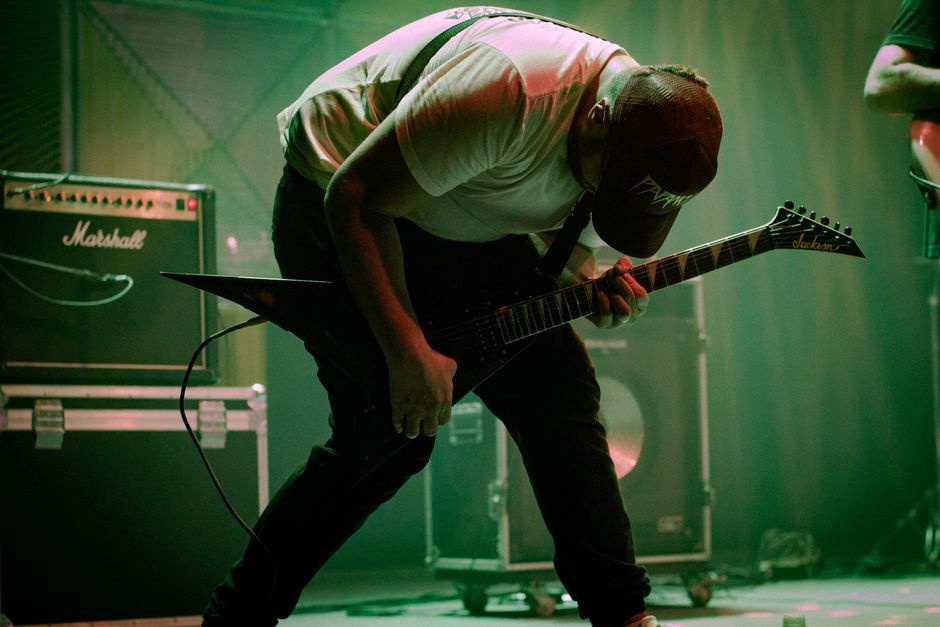
On a club stage, a solo changed the room’s focus. During a fast song, the guitarist stepping forward could hold attention while the drummer and rhythm section maintained the tempo. This was more than visual theater. It let listeners hear a player’s touch, note choice, and control of feedback in conditions where recordings could not hide mistakes or flatten dynamics.
Small venues also rewarded leads with a clear shape. A solo built around an opening bend, a repeated motif, or a dramatic final note could survive imperfect monitoring better than a dense passage that depended on every note being heard. Bands playing outside their local area faced the same problem: unfamiliar rooms and short soundchecks favored parts that communicated quickly.
The solo also created a shared reference point among musicians. Guitarists at local shows could recognize particular approaches to vibrato, harmony, or improvisation, while listeners familiar with classic thrash heard the genre’s lineage made present in a new setting. That did not demand virtuosity from every player. A clearly conceived lead break, played with conviction, could carry as much weight as a technical showcase.
Solos, authenticity, and the risks of nostalgia
Finnish thrash revival bands often used overt historical references: denim and leather visual codes, physical formats, analogue-minded production choices, and riff structures associated with the 1980s. Guitar solos were among the clearest musical signs of that exchange with the past. Yet a solo mattered only when it did more than repeat familiar squeals, tapping, or tremolo-arm effects.
Authenticity here was less about pretending the intervening decades had not happened than about committed use of a shared language. Players could draw on canonical thrash guitarists while retaining the habits of their own bands, cities, rehearsal spaces, and peer networks. A solo that sounds slightly awkward, unusually melodic, or rhythmically blunt may reveal more about a group’s character than an impeccably copied style exercise.
How to listen closely to a Finnish thrash lead break
- Identify the riff immediately before the solo. Note its tempo, tonal center, and rhythmic shape.
- Listen for whether the solo repeats, distorts, or ignores material from that riff.
- Follow the rhythm section beneath it: does the band simplify the backing, retain the main riff, or introduce a new pattern?
- Notice the ending. A return to the opening riff, a held note, or a burst of feedback frames the song differently.
- Compare studio and live versions when they are documented through legitimate releases or recordings shared by the band. The differences can show how fixed or flexible the part was.
For listeners building a focused collection, solo-focused listening pairs well with five Finnish thrash and thrash-adjacent albums worth revisiting, where album context matters as much as individual highlights. Keep notes on track titles, edition details, and the particular lead passages that catch your ear. A useful archive entry can record whether a solo is harmonized, improvised-sounding, riff-derived, or deliberately chaotic rather than simply calling it “good.”