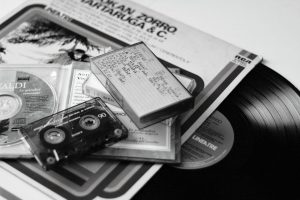
A post about a Finnish thrash demo might mention a later release, a shared concert bill, and a change in guitar sound. Any of those details could lead to another archive entry—but only if that entry answers a question the passage raises. An internal link connects pages on the same site so readers can follow that thread without having to search for it.
In a small music archive, linking every band name would make the page harder to read. The useful connections are more particular: a release and its editions, a band and its local scene, or a concert report and the recordings it discusses. A few well-placed links make those relationships easier to follow than a paragraph crowded with clickable text.
Start with the reader’s next question
Write the sentence before deciding whether it needs a link. What might a reader reasonably need to understand or verify there? If the paragraph distinguishes an original release from a later pressing, a careful comparison of the editions could help. If it merely names a city, a loosely related city overview probably will not.
Try stating the destination’s purpose plainly: “This page explains how these two editions differ.” That is a reason to link. “This page also mentions the band” usually is not. The destination should offer relevant detail that would interrupt the current post if you included it in full.
Reader questions can point to those connections. Someone asking why one release appears under two dates might benefit from a link between its discography entry and a post examining the editions. The archive’s post on how reader questions shape a Finnish thrash archive discusses the wider editorial value of listener inquiries. The decision to link still depends on what those two particular pages say.

Make a small map before editing links
You do not need specialist software to find useful connections. Make a short inventory of published posts, noting each page’s title, main subject, and the questions it can answer. Be more specific than a category label: “compares two editions of one release” tells you more than “releases.”
- Choose a starting page: Pick a published post a reader might use to get oriented to a band, recording, or period.
- Find a relevant follow-up: Look for a post that develops a point raised on the starting page.
- Find a route back: If the follow-up assumes knowledge supplied by the starting page, consider a return link where that context matters.
- Check the wording: Read the surrounding paragraph with and without the link. It should make sense either way.
The map does not mean every related pair of pages needs links in both directions. A detailed release entry may usefully point to a discussion of the local scene, while that broader piece may have no natural reason to single out the release. Let the prose decide.
Use the most specific useful destination
If a sentence discusses differences between a first pressing and a reissue, link to a comparison of those editions rather than a general Finnish thrash category page. A sentence introducing several local bands, on the other hand, may call for a scene overview instead of an entry on one record. The destination should match the scale of the point you are making.
Do not ask a page to support something it does not cover. A post about sleeve design cannot substantiate a recording date simply because it discusses the same release. If it answers only part of a question, say so in the surrounding sentence.
Write link text that tells the truth
The clickable words, or anchor text, should tell readers what they will find. “A comparison of the release editions” sets a clearer expectation than “more information.” The wording need not repeat the page title, but it should not promise a complete discography if the destination covers one recording.
Link text works best inside a sentence that already has a purpose: “The cassette and later CD differ in their listed tracks; the edition comparison records those differences.” You could link “edition comparison” if the destination does exactly that. Avoid making a whole paragraph clickable or attaching the link to an unrelated band name. Short, descriptive text is easier to scan and more useful to people using screen readers.
The words around the anchor matter too. “The edition comparison” may be clear just after a sentence about one release, but ambiguous in a paragraph covering three records. Name the release when you need to. If inserting a link makes the sentence clumsy, rewrite the sentence rather than settling for vague anchor text.
Keep the current post complete
A link offers a deeper read; it should not supply the explanation the current post owes its reader. If you claim a band changed its sound between recordings, describe what changed—perhaps the tempo, production, or arrangement—before pointing to a closer analysis. Readers should not have to leave the page to understand the basic claim.
That matters especially in archival writing, where the evidence may be uneven. If a date appears in one documented source but an edition carries another, explain the difference as far as the evidence allows. A linked post might provide photographs or source notes, but the original passage should not suggest the discrepancy is settled if it is not.
Review links as part of routine editing
Add links once the draft’s structure is stable. During revision, read each linked sentence and check that the destination still exists, matches its description, and helps at that exact point. A new page title may not call for different anchor text; a substantial rewrite of the destination might.
Look at older posts as well. When a new entry answers a question raised by an earlier one, adding a link to the older page may be more useful than packing links into the new post. It connects earlier research to later work without implying the later entry existed when the first was written.
Keep source information separate from those reading paths. An archive post can offer background or a fuller interpretation, but it is not automatically independent evidence for a historical claim. Keep citations, dates, and uncertainty beside the claims that need them. Two posts repeating the same unsupported assertion do not become better supported by linking to each other.
A final check on the page
Open the published post and follow each internal link. If possible, check it on a phone as well as a desktop: links that are easy to distinguish with a cursor can be awkward to tap when they sit close together. For a first pass through an archive, choose one release entry and add the link that best answers a question it leaves open. Note the destination and your reason in the inventory, so you can judge the edit again later.