
For Finnish thrash bands active from the late 2000s to the mid-2010s, “classic thrash” rarely meant copying a single record or national scene. The 1980s functioned more as a working vocabulary: sharply muted downstrokes, quick shifts between riff blocks, shouted gang parts, lead-guitar exchanges, and songs designed to move a small room. The influences were clear, but local groups drew differently on Bay Area precision, German severity, crossover momentum, and Finland’s own earlier metal history.
That selectivity is important. A band might use a Testament-like stop-start riff without adopting polished American production, or chase Kreator-style urgency while keeping lead work closer to traditional heavy metal. The recordings were usually recognisable as thrash straight away, yet their character rested on arrangement, guitar tone, vocal phrasing, and the practical limits of independent Finnish releases.
Classic thrash as a toolkit rather than a template
The clearest link to the classic era often lay in song construction. Finnish groups commonly favoured brief introductions, a central riff defined enough to hold together at high speed, and recurring motifs that listeners could recognise on the return. Playing fast was never sufficient on its own. A convincing thrash song needs contrast: palm-muted chugging against open-string figures, a half-time break after a speed section, or a lead passage that clears space before the next verse.
Metallica, Slayer, Exodus, Anthrax, Megadeth, Sodom, Destruction, and Kreator offered different models. Their influence was neither uniform nor equal. Bay Area records suggested intricate picking patterns and more dramatic arrangements; German thrash often pointed toward rawer tones and direct attack; crossover-informed material favoured short, physical riffs and a communal live response. Finnish musicians could shift between these approaches within a single set.

Rhythm guitar: speed with definition
Down-picked rhythm guitar marked an allegiance to early thrash, but it also demanded discipline. At rehearsal-room volume, poorly articulated fast riffing becomes a blur. Bands relied on accents, rests, and changes in picking direction to keep patterns intelligible. A riff might open with sixteenth-note chugging, leave a beat empty, then drop into a descending power-chord figure. That pause gives the drummer, bassist, and audience a common point of emphasis.
Classic thrash also favoured economical harmony. Power chords, chromatic movement, diminished shapes, and minor-key scalar runs carried much of the work. Finnish bands often brought in a distinctly Northern melodic touch through twin-guitar harmonies or more lyrical solos, while keeping the music centred on riffs. That was one way familiar genre materials could become something more than period imitation.
Drums, vocals, and the physical language of the genre
Drumming turned classic influence into a band’s live identity. Fast thrash depends on the relationship between right-hand guitar patterns and kick-drum placement. When those parts lock together, even a modest rehearsal recording can hit hard. Thrash drummers also worked with several tempo signals: D-beat or hardcore-derived propulsion, double-time snare patterns, sudden half-time passages, and short tom fills used at transitions rather than over every riff.
Vocals often separated Finnish groups from their most obvious influences. Instead of imitating a famous singer’s timbre, vocalists might choose a barked hardcore edge, a higher traditional-metal register, a rough German-thrash rasp, or a clearer shouted style. The central classic-thrash trait was rhythmic placement. Verses often followed the guitar accents closely, while choruses opened into shorter lines suited to backing vocals.
- Gang vocals made a refrain easier for a club audience to answer.
- Tempo changes gave headbanging sections a purpose instead of leaving every song at the same speed.
- Brief solos kept momentum intact and left riffs at the centre of the song.
- Dry rhythmic stops built tension before a chorus, lead break, or final return.
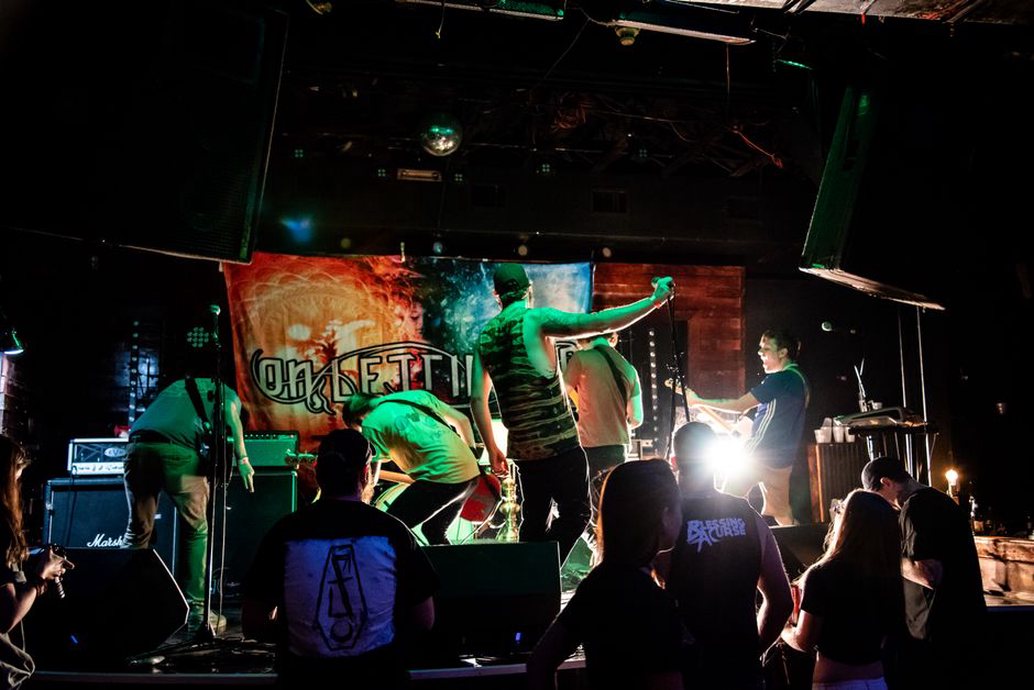
These were practical choices as much as stylistic ones. Backline, monitoring, and room acoustics could change sharply from one stage to another. A well-marked chorus and a durable main riff survive those conditions better than layers of studio detail that vanish in a crowded club.
Finnish reference points and generational continuity
Classic influence also came through Finnish precedents. Stone showed in the late 1980s that technically ambitious, internationally informed thrash could be made in Finland without losing its own character. National Napalm Syndicate represented another strand of the country’s early underground: rougher, more confrontational, and closely tied to punk energy. For later musicians, both were historical points of reference as well as records to study.
The connection should not be treated as a simple lineage. By the late 2000s and early 2010s, Finland was internationally associated with several other metal forms, including melodic death metal, power metal, doom, and symphonic styles. Choosing old-school thrash could therefore mean narrowing the focus: fewer keyboard layers, more exposed guitar work, and direct songs in place of elaborate atmospherics.
Lost Society shows how classic-thrash language could reach beyond a strictly underground setting in the early 2010s. Their early material openly drew on speed, precision, and crowd-ready riffs, while their prominence showed that younger musicians could treat an older style as living music rather than museum repertoire. Elsewhere, bands worked through demos, limited physical editions, and local bills, using the same historical vocabulary on a smaller scale.
Production choices shaped the influence
Classic-thrash influence could be heard as much in production as in composition. Independent Finnish recordings differed widely in budget and equipment, yet certain priorities returned: guitar tones with enough midrange bite to retain their attack, audible bass movement, snare sounds that cut through dense riffing, and restrained effects that did not soften the performance. Rawness alone was no virtue. If the kick drum covered the guitar or cymbals overwhelmed the mix, even carefully written riffs lost their force.
| Classic reference | Common Finnish adaptation |
|---|---|
| Bay Area arrangement detail | Multi-part songs with recurring hooks and lead breaks |
| German thrash abrasion | Lean guitar tones and forceful, less polished vocals |
| Crossover directness | Shorter songs, chantable refrains, and mosh-oriented breaks |
| Traditional metal melody | Twin leads and solos that briefly widen the harmonic palette |
Physical editions reinforced that relationship with the past. Cassette demos, CD-Rs, compact discs, patches, and small vinyl runs did not prove authenticity on their own, but they fit a culture in which listeners traded recommendations at shows and treated releases as tangible markers of a band’s development. The practical side of that process is examined in DIY Recording and Release Culture in Finnish Thrash Metal.
How to hear influence without reducing a band to its references
It is more useful to listen beyond surface resemblance than to identify a familiar guitar tone and stop there. Pay attention to how a band sets up a chorus, whether a solo develops material from the main riff, how the rhythm section handles transitions, and whether the vocal rhythm creates counterpoint. Those details show what a group absorbed from the tradition and what it changed.
- Identify the song’s main riff and count how many sections grow from it.
- Listen for the tempo shift or rhythmic break that changes the song’s physical feel.
- Compare the lead work with the rhythm guitar: does it decorate the song or redirect it?
- Notice which elements remain when production is stripped away in a rehearsal or live setting.
For collectors tracing those differences, compare an early demo, where it is officially available, with a later album or EP by the same band. Changes in riff length, vocal confidence, drum clarity, and artwork can reveal how a classic-thrash foundation developed into a more individual statement.