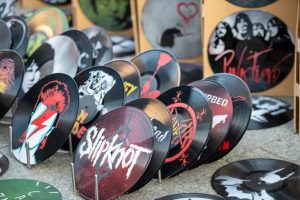
A Finnish thrash release in the late 2000s or early 2010s might start as a rehearsal-room recording, circulate as a hand-assembled demo, then lead to a tour contact or a small festival slot. This was not a lesser version of a conventional career path. For many groups, it was the practical structure that made participation possible: members booked rooms, shared equipment, designed sleeves, answered mail, arranged transport, and kept in touch with promoters and other bands.
DIY meant more than self-releasing music. In the Finnish thrash underground, it often described a shared division of labor. A band could assemble its own cassette edition while relying on a friend for screen printing, another local group for a support slot, and a small independent partner for a later vinyl pressing. Recordings, live bills, flyers, merchandise tables, and personal correspondence all supported the same scene.
DIY as shared infrastructure
Finland had a long-established metal culture, but smaller thrash bands still faced practical limits. Rehearsal spaces cost money, distances between cities could be considerable, and a niche style did not guarantee enough local listeners for regular headline shows. Cooperation helped address those limits without the need for a central organization.
Local collectives often grew out of overlapping friendships. Musicians played in more than one project; promoters also performed; graphic artists and photographers were regulars at gigs. That did not make the work casual or accidental. Small-scale activity still depended on schedules, budgets, clear communication, and a willingness to handle unglamorous jobs after the amplifiers were switched off.
Independence should not be confused with isolation. Finnish thrash bands often worked with labels, distributors, studios, clubs, and festival organizers. Their independence came from retaining initiative: approaching potential partners with a finished demo, a release plan, or a workable concert proposal rather than waiting for outside direction.

What the collective actually did
Tasks were usually divided by ability and access rather than formal titles. One member might understand recording software, another might have a vehicle, and someone else could deal confidently with venues in English or Finnish. The workload changed with each release, but the main responsibilities were familiar:
- Song preparation: arranging material in rehearsal, testing tempos and transitions, and deciding which songs were ready to record.
- Recording coordination: booking affordable studio time or preparing a usable room, checking equipment, and setting mixing priorities.
- Physical production: commissioning or creating artwork, checking track listings and credits, assembling cassette or CD-R editions, and packing orders.
- Show organization: contacting venues, combining bands into a viable bill, agreeing on backline arrangements, and promoting the date locally.
- Communication: staying in touch with labels, fanzines, radio hosts, promoters, and listeners through email, flyers, and later social platforms.
- Documentation: preserving masters, artwork files, set lists, posters, and release information that could otherwise disappear quickly.
This division of labor gave the scene staying power. If a project paused because of work, studies, military service, finances, or a lineup change, its members could still assist nearby bands as promoters, guest musicians, designers, or regular audience members. The collective extended well beyond any one name on a poster.
Rehearsal rooms as production centers
The rehearsal room was the working center of many Finnish thrash projects. It was where musicians developed the precision needed for fast, riff-led songs and established a shared vocabulary: abrupt stops, harmonized guitar phrases, changing riff cycles, gang shouts, and shifts between mid-tempo weight and full-speed attack. A disciplined rehearsal routine mattered because low-cost recording sessions left little time to solve basic arrangement problems.
These rooms also served as informal exchanges for resources and knowledge. A drum microphone recommendation, an amplifier repair, a source for blank cassettes, or a contact at a regional venue could pass between groups. Those exchanges affected the music indirectly. Bands recording under limited conditions often prioritized clear guitar attack, audible bass movement, and drums that held their definition at high tempos. The results were not always polished, but they could capture a band’s live identity with unusual directness.
Classic-thrash reference points were clear in riff construction, lead-guitar language, shouted vocals, and visual motifs. Finnish bands were not simply recreating 1980s records, however. Individual players brought in death metal, hardcore punk, speed metal, black metal, and influences from Finland’s wider heavy-music scene. Without a label department imposing a narrow commercial template, a group could keep an angular riff, a raw vocal take, or an unusual arrangement if the members felt it worked.
Physical formats and the meaning of a small edition
Cassettes, CD-Rs, and modest CD runs were practical formats, but they carried social meaning as well. A numbered tape or hand-cut, folded sleeve visibly connected the release to the people who made it. For collectors, the object may preserve details missing from digital uploads: rehearsal dates, lineup credits, logo variations, contact addresses, acknowledgments, and artwork credits.
Small editions also required care. A misspelled track title, unclear catalog number, or inconsistent credits can make later identification difficult. Even a limited run should be treated as a document. At minimum, it should state the artist, title, tracks, lineup, recording information when known, year, format, and edition details. Keeping one untouched copy alongside the original digital artwork makes later cataloguing far more dependable.
| Release element | DIY purpose | Useful record to retain |
|---|---|---|
| Demo master | Source for duplication or later reissue | Original file, tape, or disc and a dated backup |
| Sleeve artwork | Visual identity and production template | High-resolution file, artist credit, and version notes |
| Catalog number | Helps distinguish editions and collaborators | Format, run size, and label or collective name |
| Gig flyer | Announces a specific local event | Date, venue, complete bill, promoter, and city |
| Merchandise design | Raises travel funds and strengthens recognition | Print date, printer, quantities, and design variations |
Collectors should be careful not to treat every variation as evidence of a separate official edition. DIY releases could appear with changed covers, replacement cases, or home-duplicated copies without a formal reissue. Provenance matters. Contemporary receipts, direct correspondence, photographs from a merchandise table, and consistent production details offer firmer evidence than unsupported online claims.
Gig swapping, travel, and the live circuit
Concert activity relied on reciprocity. A band given a support slot in one city could later offer a visiting group a place on a local bill. The arrangement made financial sense: a stronger lineup had a better chance of drawing an audience, while shared backline reduced travel demands. It also gave listeners a reason to attend beyond seeing one familiar local act.
Finnish geography made logistics especially important. Long drives required fuel, food, sleeping arrangements, reliable contact with venues, and, in some cases, ferry planning. A low-budget tour was rarely improvised in any romantic sense. Bands needed to confirm set times, technical requirements, payment arrangements, and whether a venue supplied drums, cabinets, or basic promotion. The modest scale of a club show did not make those details less important.
European contacts widened the circuit. Exchange shows, festival appearances, and short tours could connect Finnish thrash bands with listeners in neighboring Nordic countries and elsewhere in Europe. Such opportunities usually grew through persistent networking: sending music to promoters, meeting touring musicians at gigs, building a credible live reputation, and meeting practical commitments. The process is central to the resilient spirit of Finnish thrash metal from the late 2000s to mid-2010s, where local dedication and wider connections developed together.
Why bills mattered as much as individual sets
A thrash show often became a temporary meeting point for several parts of the underground. A bill could bring together related but distinct approaches—traditional thrash, crossover, speed metal, death-thrash, or blackened styles—without demanding strict genre uniformity. That reflected how local scenes worked in practice: participants shared rehearsal spaces, venues, audiences, and friends even when their riff preferences differed.
Promoters and bands had to balance musical identity with practical concerns. A coherent bill gave the audience a recognizable thread, while a mixed lineup could bring different circles into the same room. That crossover helped a small thrash community remain visible within Finland’s wider metal culture. It is also why concert posters, set lists, ticket stubs, and photographs deserve to be treated as historical sources rather than disposable ephemera.
Aesthetic choices under practical constraints
DIY was visible in sound and presentation, but it was never a single aesthetic. Some releases embraced rough edges: dry rehearsal-room guitars, stark black-and-white artwork, photocopied inserts, and deliberately old-school logos. Others used cleaner digital recording, detailed illustrations, professionally printed booklets, or carefully mixed full-length albums. Both could still be DIY when the band or its close circle directed the process and made decisions within its available means.
Visual culture carried signals listeners understood quickly. Hand-drawn logos, skulls, warfare imagery, urban decay, comic-book exaggeration, and references to vintage metal design could place a release within thrash tradition. Effective artwork did more than repeat familiar symbols, though. It gave a project a recognizable face across flyers, patches, tapes, shirts, and online pages. The designs that lasted were often legible at small sizes and remained distinctive when reproduced cheaply.
Radio exposure occasionally offered a route beyond the immediate gig network, particularly when specialist programs and community-oriented broadcasters gave heavy music a place beside commercial programming. The relationship between local airplay, listener discovery, and scene visibility is treated in Radio’s Role in Finland’s Thrash Metal Revival. For a DIY band, radio play could not replace live work or physical distribution, but it could introduce a demo to listeners outside the band’s home city.
How to study these collectives without flattening them
Accounts of underground metal can become distorted when they focus only on releases that later became collectible or bands that secured prominent tours. A more accurate account looks at the ordinary work around them: who organized the bill, where the recording was made, how copies were distributed, and which neighboring acts shared members or stages. Those details show how the scene functioned day to day.
- Separate confirmed facts from recollection. Use dated flyers, release sleeves, venue listings, interviews, and contemporary posts to verify dates and lineups.
- Record uncertainty plainly. If a pressing quantity, exact recording date, or support slot cannot be confirmed, describe it as unverified rather than filling the gap.
- Credit non-musical contributors. Designers, photographers, sound engineers, promoters, and small-label organizers were part of the infrastructure.
- Keep local context visible. Note the city, venue type, and connections among bands before treating a release as an isolated artifact.
- Preserve legal copies and documentation. Archive purchased or artist-provided media, scans, and metadata without distributing unauthorized files.
A practical archival entry for a demo can remain simple: photograph the front and back sleeve, transcribe the credits and contact information exactly, identify the format and any numbering, note where and when the copy was obtained, and store those notes with the item. That record preserves the shared work behind an object that might otherwise survive only as an unlabeled cassette in a box.