
A Finnish thrash band on a festival bill could find itself playing to people who had never followed its local gigs. Some came for an established metal act; others came to see a support band or bought a day ticket for the mixed programme. For a small group in the late 2000s or early 2010s, reaching those listeners could matter as much as the length of the set. Musicians, collectors, organisers and curious fans might all cross paths in ways less likely at a single-band club date.
Finland did not have one unified thrash-festival circuit. Thrash appeared on broader heavy-metal bills, at local multi-band events and in club-scale gatherings. Each offered a different setting, but all gave bands a chance to play beside their peers and meet people beyond their home towns.
What counts as a festival gathering?
Calling every crowded metal gig a festival blurs a useful distinction. A festival usually brought several acts together under one programme, often for a full day or more. A multi-stage outdoor event might attract a broad heavy-music audience; an indoor gathering could feel more like an extended club show. Both could matter to thrash listeners. Neither became a thrash-only festival just because a thrash band was on the bill.
Established events such as Tuska in Helsinki and Jalometalli in Oulu offered wider metal settings, while smaller regional bills could put more weight on local performers. The event’s identity was one thing; the experience of a particular set was another. A band on a mixed bill could still give thrash listeners a place to gather.
Size changed the pace, too. At a large event, a short changeover or the pull of another stage might cut conversations short. In a compact venue, performers could stay near the audience between sets and talk about recordings, equipment or possible shows. Neither arrangement was inherently better. They simply gave people different ways to connect.
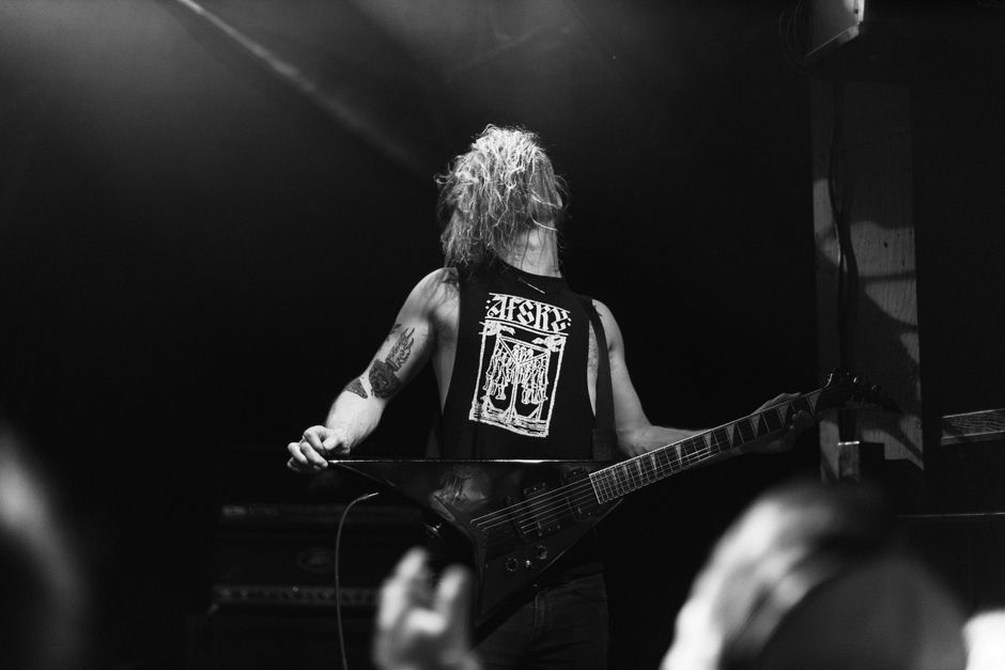
How the gathering worked beyond the set
A bill made connections visible
A festival programme placed bands in relation to one another. Playing alongside established acts could bring an underground group new listeners, while the shared bill also gave its music context. Over the course of a day, someone could hear a young thrash band’s rapid picking and shouted vocals beside death metal, traditional heavy metal or newer extreme music. Thrash had a place in Finnish metal culture without needing a separate genre-only space.
Running order mattered, but it was no simple measure of artistic worth. An early slot could mean a shorter set and fewer people in the room, yet some of those listeners might never have gone to the band’s own show. A later slot brought different expectations and other claims on the audience’s attention. A festival booking shows an opportunity, not a reliable measure of popularity.
Records and conversations travelled together
At the merch table, a musician could pass someone a physical release and explain which songs were new or where the group had played. A listener could check the sleeve and track list before buying directly from the band. Independent recordings travelled between towns through exchanges like these. For collectors, the conversation might also clarify which version of a recording was on sale that day.
Money was only part of it. Musicians watched each other play, organisers met potential support acts, and fans passed along recommendations. A meeting might lead to another show—or simply help someone remember a band’s name. Sharing a bill is not, by itself, evidence of a later tour, collaboration or record deal.
- For listeners: a multi-band ticket offered a way to discover local acts beside familiar names.
- For musicians: time between sets brought them into contact with performers and organisers from other towns.
- For collectors: a merch table let them inspect formats and editions in person.
- For organisers: the crowd’s response offered a sense of how different styles worked together on a bill.
Why mixed metal programmes mattered to thrash
Finnish thrash bands worked in a country associated with many kinds of metal, and festival programmes reflected that breadth. Sharing a day with death, black, power or traditional heavy metal did not necessarily blur a thrash band’s identity. The contrast could bring its tightly stopped riffs, quick rhythmic turns, prominent bass passages or barked vocals into sharper focus.
At a club show, friends might already know the songs and recordings. At a festival, a band could face people hearing it for the first time, often within a short set. Strong openings, clear pauses and an audible guitar-and-drum attack could register quickly. That describes the demands of the setting; it does not mean every Finnish group changed its music for festivals.
Posters showed how organisers presented those relationships before anyone played. Type size, running order and stage assignment tell us about the advertised programme; photographs and audience memories offer a different view of the day itself. A small name on a poster might have drawn an enthusiastic room. Prominent billing, meanwhile, tells us nothing certain about who stayed for the whole set.
Local belonging without a single scene centre
Helsinki, Oulu and other Finnish cities had their own venues, promoters and audiences. A festival could bring those networks together for a day without making them identical. Someone who knew a band through hometown shows might meet listeners from elsewhere at its festival set. A visiting group could hear how a regional crowd responded to songs usually played closer to home.
Getting there took work. Musicians had to arrange transport, backline, set times and somewhere to sell releases. Fans balanced ticket prices and travel against the chance to see several acts in one trip. These practicalities shaped the crowd. A thinly attended early set was not necessarily a sign of weak interest: travel times, competing stages and scheduling could all play a part.
Community meant labour as well as enthusiasm. Someone booked the room or stage, assembled the bill, handled sound and made space for performers and listeners. That work can vanish when festival histories become lists of band names. The blog’s account of women musicians, organisers and archival visibility in Finland’s thrash revival looks at why such a narrow record needs care.

What a festival appearance can—and cannot—tell us
For anyone tracing the scene from the late 2000s to the mid-2010s, a festival appearance is a useful fixed point—but the evidence has limits. A dated programme establishes that a band was advertised. A set list or a firsthand photograph may help establish what happened onstage. A poster cannot prove that every listed band played, and a photograph from one song cannot confirm the whole set.
Event names need dating, too. A festival could change venue, duration or musical emphasis between editions. The full bill for a particular year says more than an event name treated as a permanent description of its audience. One booking cannot stand in for a band’s whole concert history; it belongs alongside its local gigs, recordings and travel.
Useful materials to keep together include:
- A programme or running order bearing the event name and year.
- Venue and stage information, where available.
- A photograph with a known photographer and a reliable date.
- A ticket, wristband or flyer that identifies the event edition.
- Notes distinguishing advertised performers from confirmed performances.
Kept together, these details preserve more than a list of bands. A flyer shows how an event addressed its audience; a running order shows which acts shared time and space; a merch-table note can tie a physical release to a particular occasion. An archive cannot recover every conversation, but it can document the circumstances in which those conversations happened.
Listening to the gathering, not just the recording
A festival set could reveal things a studio release could not: how a band handled a brief changeover, where it left pauses, or how an unfamiliar crowd responded to a new song. A rough live recording has limits of its own. Microphone placement and room acoustics may say more about the recording than about the sound the band intended. The strongest accounts separate what can be heard, what other evidence supports and what remains a listener’s impression.
A modest comparison can be revealing. Put a dated programme beside an independently issued recording from the same period and check which listed songs appear on both. If a surviving set list names a track absent from the release, note the difference. Without further evidence, there is no reason to call it new, renamed or unreleased.