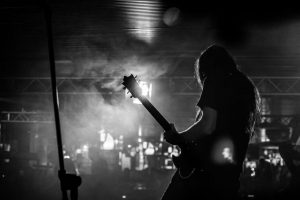
Stone’s “Get Stoned” makes its opening riff count before a solo enters. The clipped, repeated guitar attack is the hook. Listen past the distortion: the spaces between notes, the accents that unsettle the pulse, and the guitar’s timing with the drums give the part its shape. Finnish thrash has no single riffing formula, but tight picking and sharply defined rhythm offer a useful way into its guitar history.
That history is not a sound handed down unchanged. Musicians could borrow, discard or reshape palm-muted low notes, abrupt stops, fast alternate picking and ringing chords used as punctuation. They also had to make riffs work in the noise of a small venue. Those choices tell us more than grouping every Finnish band with a fast song into one school.
What makes a thrash riff recognizable?
A riff is a repeatable musical figure, not just a fast guitar passage. In thrash, it often carries the song’s pulse while giving the drummer and vocalist something to push against. Palm muting—resting the picking hand lightly near the bridge—shortens notes and makes low strings sound percussive. Open strings or unmuted chords then hit harder as accents. It is the contrast that does the work.
Speed can hide differences in picking. An even run of notes drives forward; a short burst followed by silence lurches. Move a figure to a higher string, or shift its accent by a beat, and it can feel different without changing its basic notes. These details are often easiest to hear when a riff returns beneath a vocal after an instrumental introduction.
- Attack: Are notes clipped, sustained, or alternated for contrast?
- Pulse: Does the guitar follow the kick drum, mark the backbeat, or play across it?
- Harmony: Do single-note lines, power chords, or both carry the movement?
- Transition: Does a stop, fill, or new accent announce the next section?
These are listening questions, not rules for genre membership. Sometimes a riff sticks because it breaks the pattern around it.
The first wave: precision without one template
Stone, formed in the 1980s, remains a central reference for Finnish thrash guitar. Their self-titled debut appeared in 1988, followed by No Anaesthesia! in 1989. In those early recordings, fast rhythm playing makes room for tempo changes and carefully placed melodic movement. That does not mean every later player copied Stone. The records show how technical control could serve songs built on contrast rather than nonstop speed.
Listen to the length and placement of the phrases. A run of tightly muted notes may end on an open chord, leaving room for the drummer to signal a turn. A lead line draws the ear, but the transitions into and out of it can be more revealing. The riff has a job within the arrangement.
Other first-wave bands make a tidy lineage difficult. Airdash and Prestige belong in accounts of late-1980s Finnish thrash, but their records do not share one uniform national guitar tone with Stone. Compare the structures instead: who builds around a repeated rhythmic cell, and who interrupts it with a turnaround or contrasting section? That gets closer to the music than claiming Finnish thrash was simply more melodic or more aggressive than thrash elsewhere.
International metal and hardcore punk supplied a shared vocabulary; national identity cannot explain every picking technique. What matters locally is how Finnish bands put familiar ingredients into their own songs, carried those songs into live sets, and left recordings for later players to study.
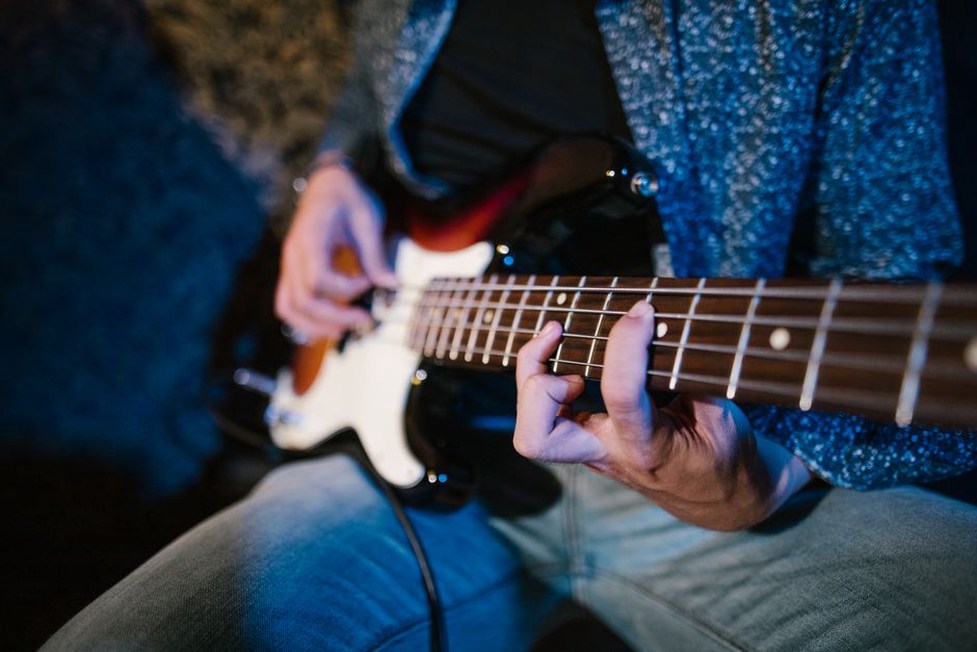
Between generations: when “thrash” became a flexible description
A straight line between the 1980s and the revival years misses the metal made in between. Mokoma, formed in the 1990s, is a useful Finnish example: its heavier direction could accommodate thrash-derived rhythmic guitar playing without reconstructing an old-school sound. Finnish-language vocals and a broader heavy-metal context also matter here. Thrash riffing can be part of a band’s vocabulary without defining all of it.
Nor does every clipped low-string pattern point directly back to Stone. A guitarist can carry a technique forward without recreating an entire 1980s style; a thrash-inflected riff might sit beside slower, heavier material. Listen at the joins between sections. Does the guitar keep up its brisk picking, drop into a half-time feel, or make room for the vocal? That is often where an older technique takes on a different role.
The revival years: old materials, different hands
By the late 2000s and early 2010s, younger Finnish bands had decades of recorded thrash to draw on. Speedtrap favored a sharp, fast attack, while Lost Society’s early recordings brought high-energy thrash to a new generation of listeners. Lost Society’s debut, Fast Loud Death, appeared in 2013. Both drew on older materials, but they arranged speed, hooks and rhythmic changes differently; there is no single “revival sound.”
A rapidly picked low-string figure can announce classic thrash in seconds. What happens next gives the song its own character: the band might change the chord beneath it, cut it short for a drum fill, or introduce a contrasting figure under the chorus. That is arrangement, not merely dexterity.
The revival also put older aesthetics back in view: forceful right-hand playing, compact riff sections and performances that showed the physical work of guitar playing. Still, a polished recording cannot tell us whether every note sounded identical onstage. Layering, editing and amplification all affect what we hear. Live footage can show hand movement and band interaction, though its sound quality varies; for close note-by-note comparison, a clear passage on an issued recording is more dependable.
How the rhythm section changes what a riff means
Thrash guitar does not generate all the momentum on its own. Put a kick drum under each short guitar note and the pick attacks feel more pronounced. Set the snare against the figure and it may seem to lean forward. If the drums shift to a slower-feeling pattern while the guitar keeps its pace, the notes stay the same but the riff gains weight.
Bass has a similar effect, even when a dense mix makes it hard to isolate. It can reinforce root notes, underline a chord change, or complete a pause before the next downbeat. On a thinly recorded demo, the apparent heaviness of the guitar may owe more to the ensemble’s timing than to its tone. Replay a passage with your attention on the kick and bass to hear the difference.
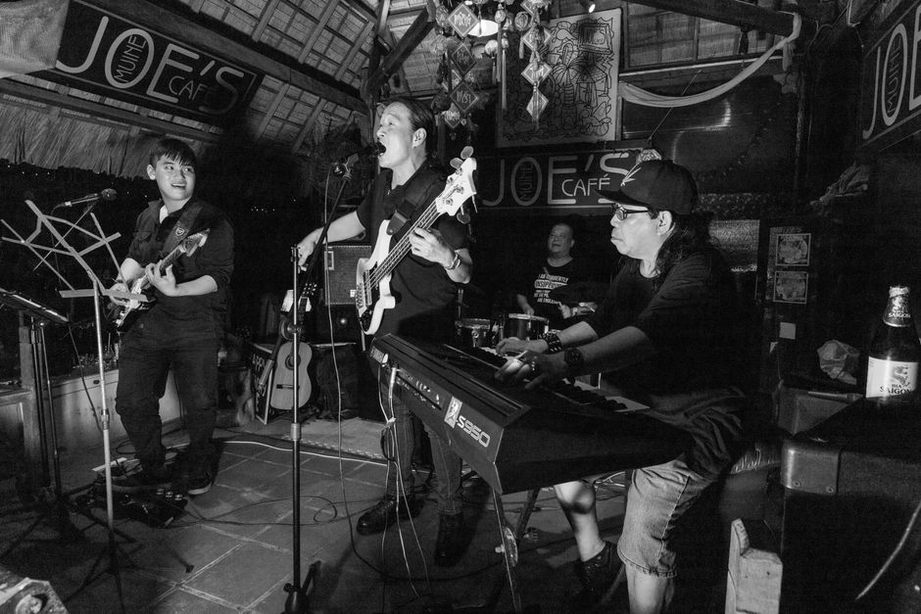
A live set puts the arrangement to another test. A complex sequence must remain legible while musicians move, monitor sound is imperfect, and the crowd reacts to shifts in pace. Short rests, repeated accents and clear starts help the band hold together as well as shape the song. For more on that connection, see how Finnish thrash bands built live sets from rehearsal-room material.
Reading guitar tone without mistaking it for genealogy
Distortion is expressive, but it is a poor shortcut to identifying influence. Two recordings might sound similarly harsh or bright because of their amplifiers, microphones, mixing choices or recording limitations. Similar riffs, meanwhile, can seem unrelated if one mix emphasizes pick attack and another leaves more room for bass and cymbals.
Start a comparison with what survives a change in tone. Hum the riff’s rhythm without worrying about pitch, then mark where its chords change. When it returns later in the song, has it kept the same pace, been shortened, or moved under a different drum pattern? This separates the musical idea from the sound of a particular album, demo or live recording.
A compact listening exercise
- Choose one Stone track and one Finnish release from the 2010s, using complete, legitimately issued recordings.
- Find a riff that appears at least twice in each song. Mark its first note, final accent and any rest.
- On its second appearance, listen for changes in drums, bass and vocals before judging the guitar part.
- Describe what changed plainly: “shorter final chord” tells you more than “more technical.”
This cannot establish direct influence between the bands. It gives you musical decisions to compare without ignoring the differences in players, decades and recording conditions.
What the surviving recordings can—and cannot—tell us
Official albums preserve finished arrangements, not every revision made in rehearsal. A demo may reveal a rougher version of a riff, but a difference between recordings does not necessarily mean the composition changed; performance or production may explain it. Live documentation captures how a part was played on one occasion, not how it sounded throughout a tour.
Discography dates and credits are firmer anchors than stories about who taught whom a lick. Unless a guitarist has named a specific influence, resemblance alone cannot prove one. What the recordings do show is Finnish musicians finding different uses for thrash guitar’s physical and rhythmic techniques.
For a closer listen, choose a returning riff from No Anaesthesia! and write down only its rests and accents. Do the same with a track from Fast Loud Death. Leave the solos aside on the first pass: the spaces around the rhythm notes give you two concrete arrangements to compare.