
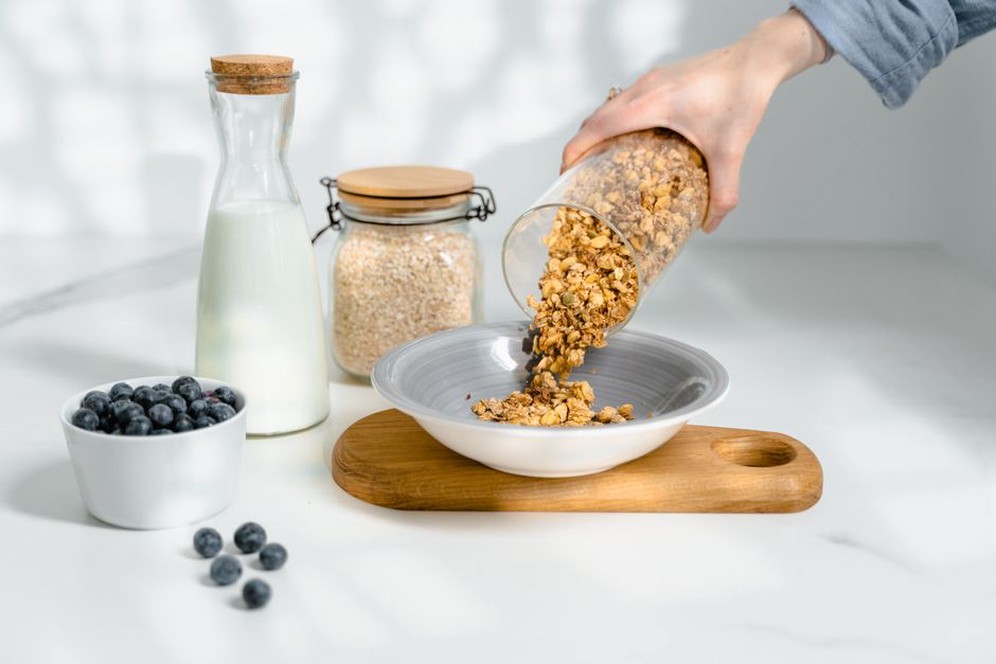
A cereal box may list 8 grams of sugar per serving. If that serving is one cup and you usually pour two, your bowl has about 16 grams. Check how much you actually eat before interpreting the rest of the label.
Start at the top: serving size and servings per container
On a U.S. Nutrition Facts label, serving size reflects an amount people typically eat, not an amount you should eat. It may be given in cups or pieces alongside a metric weight. Servings per container tells you how many of those portions are in the package. Your usual portion may be quite different.
If a package contains two servings and you eat the whole thing, you generally get twice the listed calories and nutrients. Some packages make this easier with two columns: one per serving and one per container. For loosely packed foods such as cereal or chips, the gram weight may be more useful than the cup measure, since one person's cup can hold more than another's.
Use calories as context, not a verdict
Calories tell you how much energy is in a labeled serving, but not whether the food will satisfy you or what else it supplies. A small portion of nuts can be calorie-dense and contain unsaturated fats; a lower-calorie snack might have little fiber and leave you hungry soon afterward. The portion and the food's place in a meal both matter.
Check serving sizes before comparing similar products. If one soup lists calories per cup and another per half-cup, the numbers aren't directly comparable. Put them on the same basis first.
Read the nutrient lines with your purpose in mind
The panel lists fat, carbohydrate, protein, and selected vitamins and minerals. You needn't give every line equal weight. Sodium might be your first concern when choosing canned soup; for breakfast cereal, fiber and added sugars may tell you more.
Fat: check the type as well as the total
Total fat includes several kinds of fat. U.S. labels list saturated fat and trans fat separately. More total fat does not automatically make a food a poorer choice: olive oil and nuts contain substantial amounts, much of it unsaturated. Consider saturated fat in the portion you eat and in the context of your overall diet, rather than using total fat as a score.
Carbohydrate: separate fiber and added sugars
Total carbohydrate includes starches, sugars, and dietary fiber. The fiber line helps you see what a food offers beyond quick-digesting carbohydrate. Total sugars includes sugars naturally present in foods, such as milk or plain fruit. Added sugars refers to sugars added during processing or preparation. It is part of the total, not another amount to add to it.
If a flavored yogurt lists 14 grams of total sugars and 8 grams of added sugars, it has 14 grams of sugar—not 22. Comparing it with plain yogurt can help show the effect of sweetening, as long as the serving sizes are similar.
Protein, sodium and other nutrients
Protein grams are useful when comparing foods that serve the same purpose, such as two yogurts or sandwich fillings. A higher number does not, by itself, make something a complete meal; consider the portion and what you eat with it. Sodium is also worth checking in packaged foods such as sauces, bread, and ready meals. Ordinary servings can add up over a day. U.S. labels include calcium, iron, potassium, and vitamin D; which of these you need to watch depends on your eating pattern and health needs.
What the percent Daily Value can—and cannot—tell you
The percent Daily Value (%DV) shows how much one serving contributes to a reference daily amount of a nutrient. U.S. labels use a 2,000-calorie diet as the reference, though your energy needs may differ. As a quick guide, 5% DV or less is generally considered low and 20% DV or more high. Those figures can help you compare foods when you're looking for more fiber or less sodium.
You don't have to hit every percentage with every food, and adding unrelated percentages together won't give you a useful grade. Protein may appear without a %DV on some labels. Think about the meal, too: a low-fiber pasta sauce can be part of a fiber-rich meal with whole-grain pasta and vegetables.

Look beyond the Nutrition Facts panel
The ingredient list tells you what went into a product. Ingredients are generally listed in descending order by weight. That can help you distinguish a whole-grain bread from one made primarily with refined flour, though it won't tell you exact quantities. If you have a food allergy, check the full package for allergen information; the nutrient panel cannot tell you whether a food is safe for you.
Front-of-package phrases such as “natural,” “high protein,” or “made with whole grains” highlight one feature, not the whole food. Even regulated claims have specific meanings that may differ from what you assume. Check the serving size, nutrient amounts, and ingredients on the rest of the package before relying on a claim.
A practical comparison in the grocery aisle
Suppose two crackers come in different-sized boxes. One lists 140 calories, 3 grams of fiber, and 220 milligrams of sodium per 30-gram serving. The other lists 110 calories, 2 grams of fiber, and 180 milligrams of sodium per 20-gram serving. The second appears lower on each count, but its serving is one-third smaller. Per 30 grams, it would provide about 165 calories, 3 grams of fiber, and 270 milligrams of sodium.
When the choice matters, work through four checks:
- Match the portion: compare what you expect to eat, or calculate values for an equal weight.
- Pick the relevant lines: perhaps sodium for soup, added sugars for cereal, or fiber for bread.
- Check ingredients and allergens: the nutrient numbers cannot answer every question.
- Consider the meal: one product does not have to supply every nutrient on its own.
Small amounts may appear as zero because of rounding rules, so “0 grams” does not always mean none at all. Label formats also vary by country; a product bought abroad may use a per-100-gram column or different reference percentages. Whatever the format, compare the same quantity before drawing a conclusion.
For a package labeled as four servings, eating half means multiplying the per-serving figures by two—not four. That gives you the numbers for your portion, no matter what benefit the front of the package emphasizes.