A Finnish thrash riff from the late-2000s revival may begin with a tightly muted low-string pattern, yet its character often emerges in the details around it: a clipped chord reply, a sudden melodic rise, an off-beat accent, or a brief opening for bass and drums. The best bands understood that speed alone was not an arrangement. They treated classic thrash vocabulary as material to shape through Finland’s metal history, local rehearsal culture, and the realities of small stages.
Classic thrash as the central language
The clearest reference points came from the thrash traditions established in the 1980s. Bay Area bands offered tightly picked, palm-muted momentum and agile chromatic movement. German thrash brought a harsher, more martial attack, while crossover records showed how a riff could be blunt and memorable without becoming simplistic. Finnish musicians in the 2000s and early 2010s encountered these records through original pressings, reissues, used-CD bins, online discussion, and concert networks. The influence was musical rather than visual: down-picked eighth notes, tremolo-picked transitions, diminished-color runs, galloping figures, and abrupt stop-start arrangements remained practical tools.
Still, these influences were not simply copied. On paper, a riff built around an E-string pedal tone and a minor-second shift may resemble dozens of older songs. Its identity depends on tempo, articulation, chord voicing, the moment it turns, and the drummer’s placement of the beat. Finnish thrash groups often stressed clean endings and coordinated hits, which gave familiar patterns a more deliberate feel.
What riff writers borrowed from the classic canon
- Bay Area economy: a short rhythmic cell developed through accents, rests, and changes in chord position instead of simple repetition.
- German directness: rapid minor-key riffs, forceful unison figures, and a physical sense of forward motion.
- Technical-thrash tension: chromatic turns, asymmetrical phrasing, and riffs that naturally lead into contrasting sections.
- Crossover clarity: a memorable mid-tempo motif set against faster material, giving a song a dependable live anchor.
Finnish heavy metal before the revival
Finland’s own metal history mattered as much as imported records. Stone, active during the original Finnish thrash wave, provided a lasting local example of technically assured songwriting: rapid rhythm guitar could sit alongside melodic detail, sharp transitions, and instrumental fluency. Later players did not need to borrow Stone’s individual phrases to take in that lesson. The important inheritance was the freedom to make thrash precise, composed, and recognizably Finnish without softening its aggression.
Other domestic metal traditions widened the available vocabulary. Finland had strong currents in melodic heavy metal, speed metal, death metal, black metal, and progressive playing. A thrash guitarist raised on those styles was likely used to minor-key leads, harmonic movement beyond basic power-chord shifts, and a broader sense of atmosphere. That did not make every revival-era riff melodic or progressive. More often, those instincts surfaced in a turnaround, a twin-guitar response, or an instrumental bridge that interrupted an otherwise blunt attack.
The result was a balance between severity and contour. Where a strictly revivalist approach might stay on one pedal note for maximum force, Finnish players often gave a phrase somewhere to go: a rising two-note figure, a harmonized answer, or a chord sequence that briefly opens the tonal field before the main riff returns.
Melody, darkness, and the minor-key instinct
Finnish thrash riffs often draw power from melody without losing their edge. Minor thirds, semitone friction, descending lines, and harmonized intervals can make a fast passage feel colder or more ominous than a purely percussive alternative. Such choices connect thrash to the wider Finnish metal tradition, where memorable guitar lines have long mattered across stylistic boundaries.
Melody in thrash is not limited to a chorus or lead break. It can sit inside the rhythm part itself: a note sequence that suggests a clear line rather than a chord shape. One guitarist may alternate muted single notes with ringing dyads; another may double the contour at an interval; the bass may hold the root while the drums maintain a driving thrash pulse. The riff remains aggressive, yet it gains a sense of motion.
Riff devices that create this darker contour
| Device | Musical effect | Typical use |
|---|---|---|
| Chromatic descent | Pressure and instability | Transitions into a verse or breakdown |
| Minor-second movement | Cold, abrasive tension | Fast pedal-tone riffs and chord stabs |
| Harmonized line | Lift without losing weight | Instrumental passages and pre-choruses |
| Open-string pedal tone | Speed and resonance | Verses, intros, and accelerations |
| Brief clean or ringing chord | Contrast and reset | Before a main riff re-enters |
Punk urgency without reducing the riff
Hardcore and punk influence involved more than faster tempos. It shaped the physical logic of a riff: short phrases, emphatic rests, group shouts, and sections built to land clearly in a crowded room. A two-bar figure with a well-placed silence can hit harder than a busier passage, especially when the whole band stops and resumes together. That approach preserved thrash’s social energy even as arrangements became more detailed.
For Finnish bands playing clubs, rehearsing in shared rooms, or building audiences through independent releases, this economy was practical. A riff had to communicate through imperfect monitoring and uneven venue acoustics. Clear rhythmic shapes survived distortion, volume, and a loud audience. Technical writing still had its place, but its details needed to serve a pulse listeners could follow.
The connection to punk is best understood through attack and structure. A riff can use sophisticated picking patterns while functioning almost like a chant: establish a recognizable shape, repeat it just enough, then interrupt it when the listener expects another cycle.
Precision shaped by rehearsal and performance
Thrash riffs rely on collective timing more than individual guitar skill. Finnish revival-era groups often arranged guitars, bass, and drums around the same accent pattern, then let the instruments separate briefly for contrast. That kind of writing rewards disciplined rehearsal. A small change in muting, pick direction, or cymbal placement can determine whether a riff sounds urgent or simply rushed.
Live performance also revealed which ideas held up. Fast riffs had to remain intelligible after an intro, between songs, and within a set that moved through different energy levels. Bands benefited from placing relentless passages beside mid-tempo sections, swing-inflected beats, or half-time weight. These contrasts were not concessions to accessibility; they made the return to high speed hit harder.
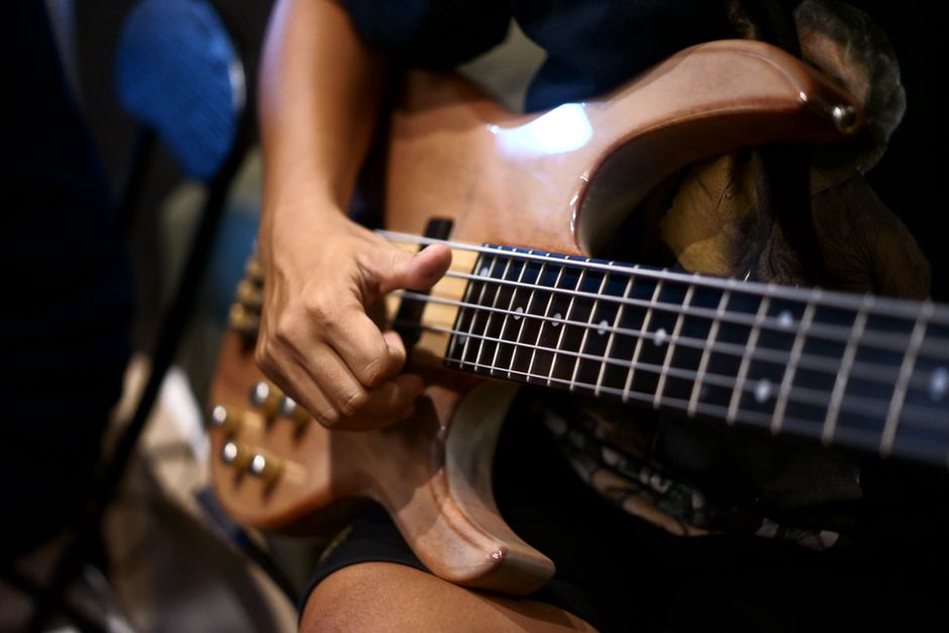
The bass is particularly important here. When it doubles a guitar riff exactly, it can add weight to the attack. When it moves independently for a bar or two, it can clarify harmonic motion that distorted guitars blur. The blog’s discussion of bass as the backbone of Finnish thrash metal provides useful context for hearing how low-end arrangement changes a riff’s perceived force.
Independent-era listening and international exchange
The late 2000s and mid-2010s were not an isolated revival contained within national borders. Demos, compact discs, vinyl editions, online clips, fanzines, and touring bills connected Finnish groups with the wider European underground. That contact renewed interest in old-school thrash while exposing musicians to related styles: speed metal, blackened aggression, traditional heavy-metal leads, and contemporary extreme-metal production.
International contact could sharpen a band’s decisions. Hearing another scene’s more primitive riffing might encourage a Finnish group to strip a part back; technically ambitious peers could inspire tighter transitions or more adventurous harmony. The shared underground language made comparison possible, while local preferences kept the results from becoming uniform. For a wider account of those connections, Finnish Thrash Metal’s influence on European underground scenes traces the exchange between Finnish artists and their continental counterparts.
How to hear the influences in a single riff
Instead of asking which famous band a passage resembles, listen in layers. Start with the rhythmic engine: straight down-picking, a gallop, a syncopated chug, or a stop-start figure. Then follow the pitch movement. Does the riff remain on a pedal tone, descend chromatically, climb through a minor scale, or turn into a harmonized response? Finally, hear what the arrangement does around it: does the bass double the line, do the drums mirror its accents, and does the next section deliberately oppose its tempo or mood?
Try replaying a verse riff and marking four points: its opening attack, its first note change, its strongest accent, and the final beat before it repeats. Those moments can reveal several lineages at once—classic thrash discipline, punk economy, melodic-metal contour, and the rehearsal-room precision that makes a set of influences work as a single riff.