
Finnish thrash shows of the late 2000s and early 2010s rarely depended on props or rehearsed movement. Most bands played compact club stages with limited lighting, rushed changeovers, and barely any distance between performers and crowd. Their visual impact came through practical details: a tightly counted intro, a guitarist stepping forward at a riff change, a vocalist setting up the next song in a few words, and a drummer holding a pace that left no room for hesitation.
That economy suited the music. Bands drawing on 1980s speed and precision treated the stage as proof that their songs could hold up under close scrutiny. Fast down-picked riffs, abrupt stops, and lead exchanges had to stay clear and coordinated in real time. A convincing set was not simply loud. It needed structure: a controlled opening, a sustained middle, and a final run that released the energy building in the room.
Presence built from playing, not spectacle
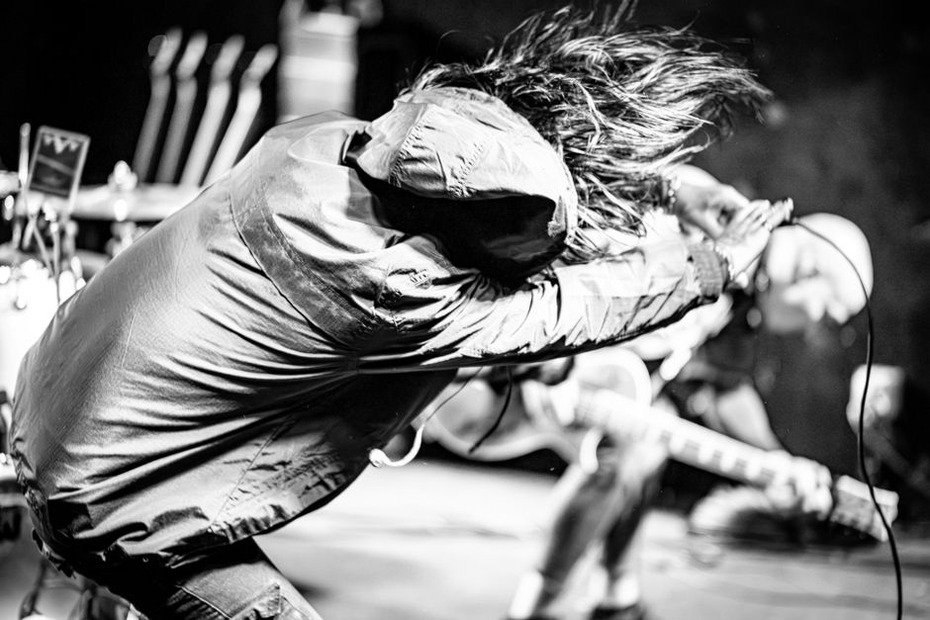
Classic thrash has always had a physical vocabulary: headbanging, wide stances, raised instruments, shouted cues, and a crowd moving with the riff. Finnish revival-era bands used those conventions within the practical limits of the underground circuit. On a small stage, a five-piece might have had little space beyond the area occupied by amplifiers, drum hardware, monitors, and shared backline.
Presence therefore relied more on timing than scale. A synchronized pause before a chorus, or the whole band dropping into a half-time riff, could refocus the room without anyone needing to cross the stage. Strong performances made the arrangement easy to read: listeners could feel the move from a rapid verse to a more open hook, hear a solo pass between guitarists, or recognize when the rhythm section pulled back before a final acceleration.
This matters when watching archival footage. A fixed camera can make a club set look restrained beside a large festival production. What it may miss is the close interaction underneath: musicians listening for a transition, a singer placing a cue against the drummer’s count, or people in the crowd reacting to a familiar riff before the vocal begins.

The room shaped the performance
Finland’s metal infrastructure included rehearsal spaces, youth centres, bars, clubs, and festival stages, each creating a different relationship between band and audience. At a small indoor show, the front row could stand almost level with the musicians. The line between performance and participation was thin: fans could sing a chorus back at the vocalist, call out in response to song titles, or start a circle pit within seconds of a recognizable opening riff.
That proximity favoured direct communication. Thrash vocalists usually kept remarks brief: a greeting, dedication, invitation to move, or announcement of the next number. Long speeches could break momentum, especially during a support slot. The aim was not arena-scale command, but a connection maintained through the rhythm of the set.
Festival appearances called for a related skill set. A band facing unfamiliar listeners had less time to earn attention and had to project across a wider space. Quick starts, memorable choruses, confidence during instrumental passages, and disciplined transitions became especially important. A festival crowd might include devoted metal listeners, casual attendees, and people waiting for another act; a clear live presentation gave each group an immediate way into the performance.
The physical character of venues is central to understanding this culture. Our guide to iconic venues of Finnish thrash metal provides useful context for the stages and local circuits where these performance habits developed.
Set construction as a live craft
A thrash set is not simply an album played in sequence. Songs written for a record may have abrupt endings, extended intros, difficult tempo changes, or tonal shifts that need reconsideration in a noisy room. Finnish bands working independently often refined material through rehearsal and repeated performances, learning which passages drew an immediate response and which needed a clearer lead-in.
Opening with certainty
The opening song had a straightforward task: establish the band’s sound before attention drifted elsewhere. A short, unmistakable riff or a direct attack usually worked better than a long atmospheric build. For newer groups, the first minute also demonstrated technical reliability. When the guitars locked with the drums and vocals came through the mix cleanly, the audience could settle into the set quickly.
Balancing speed, groove, and recovery
Relentless velocity can be exciting, but a set built entirely from similar tempos can flatten its own effect. Strong thrash performances often placed a more stomping, mid-tempo song after several faster tracks. The change gave both musicians and audience another kind of physical release: less frantic movement, more collective headbanging, and a better chance for a chorus to land.
That balance also protected the performance. Fast material demands concentration and stamina. A well-placed groove-led section could preserve the precision needed late in the set rather than exposing fatigue through rushed rhythms or loose guitar synchronization.
Ending with a recognizable release
For a local audience, the closing song often worked best when it had a memorable refrain, a durable riff, or an ending that invited one last surge of movement. It did not have to be the fastest piece. A slower, heavily accented conclusion could be more effective if it gave the crowd a shared cue and let the band finish together rather than stopping after a blur of notes.
- Tempo contrast: Pace the set so fast songs feel faster rather than interchangeable.
- Clear transitions: Keep dead air between songs to a minimum, especially in short sets.
- Rehearsed endings: A unified final hit makes a stronger impression than an uncertain fade-out.
- Adaptable sequencing: Change the order when the room, time slot, or technical situation calls for it.
Musicianship was part of the visual identity
Finnish thrash of this period was often marked by disciplined ensemble playing. That quality was visible as well as audible. Twin-guitar arrangements required players to coordinate their positions and listen closely through changes. Bassists helped bind the rhythm section by staying physically connected to the drummer’s pulse instead of treating their role as purely background support.
Drummers, though often partly hidden behind the kit, carried a particular visual responsibility. Crisp stick lifts, decisive fills, and clean transitions signalled control. A drummer who could sustain a rapid beat without appearing rushed made the whole band seem more assured. The same applied to guitarists: precise right-hand technique and clean harmonized passages reinforced thrash metal’s emphasis on exactness.
For that reason, flashy movement was not always the point. A guitarist cannot turn every riff into a theatrical gesture when a difficult passage demands accurate fretting and picking. The strongest performers found a practical balance: movement in open sections, a grounded stance during intricate parts, and a visible release when the arrangement allowed it.
Audience participation and the local ethic
The audience was an active part of Finnish thrash concert culture. Headbanging, raised fists, shouted refrains, and mosh activity gave immediate feedback to the stage. In smaller rooms, performers could judge the response at once and adjust their energy. A quiet crowd did not necessarily signal rejection; people may have been listening closely, conserving energy, or hearing the material for the first time. Experienced bands invited participation without demanding a forced reaction.
Respect for the room mattered. Thrash shows can be physically intense, but a sustainable local scene depends on basic awareness: helping someone up after a fall, refusing violence disguised as moshing, respecting venue staff, and leaving space for people who want to watch without joining the pit. These habits were especially important on mixed bills, where punk, traditional metal, death metal, and crossover audiences could bring different expectations.
The scene’s loyalty came through repeated contact between bands and listeners rather than distant branding. A broader account of how Finnish thrash metal built a loyal fanbase without marketing helps explain why familiar faces, affordable releases, and regular live appearances mattered so much.
Touring beyond Finland without losing the character
European underground touring put Finnish groups in unfamiliar rooms with shared equipment, compressed schedules, and audiences who might not know the catalogue. Those conditions rewarded self-sufficiency. Bands had to set up quickly, soundcheck decisively when time allowed, and deliver a coherent performance despite uneven monitors or unfamiliar backline arrangements.
The core stage language travelled well because it needed little explanation. A sharp riff, a unified count-in, and a committed response to the crowd were legible anywhere. Touring could also sharpen a band’s sense of identity. On a mixed European bill, a Finnish group could draw on the clean, disciplined attack associated with its local tradition without presenting itself as a nostalgic imitation of an earlier American or German model.
| Live element | Why it mattered in underground thrash |
|---|---|
| Tight count-ins | They prevented awkward gaps and showed ensemble discipline. |
| Visible guitar interplay | It made harmonies, solos, and riff exchanges easier to follow. |
| Short stage talk | It protected momentum in club and support-slot conditions. |
| Responsive set order | It allowed bands to react to the room’s energy and technical limits. |
| Clear final songs | They gave audiences a memorable collective endpoint. |
How to read live documents responsibly
Setlists, flyers, photographs, fan-shot clips, and concert recollections are valuable records, but each has limits. A flyer can show that a bill was advertised, not necessarily that every act performed. A video may capture one song with distorted audio or an incomplete view of the room. Memories can preserve atmosphere while confusing the sequence, venue details, or date. Cross-checking sources is the safest way to reconstruct performance history without turning assumptions into fact.
For collectors and researchers, the most useful details are often modest: the venue name as printed, the date, the bands listed, whether an item is an original handbill or a later reproduction, and any confirmed recording source. When documenting a live set, distinguish a verified setlist from a partial song list heard on available footage. That basic archival discipline keeps Finnish thrash concert culture tangible without filling its gaps with invented stories.