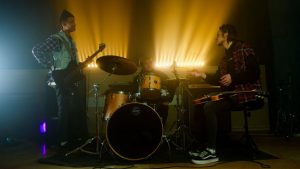
A thrash drummer’s kick can vanish beneath distorted guitars before the band gets anywhere near a studio. In a small rehearsal room, that matters: if the players cannot pick it out from the bass guitar, a fast passage may feel tight without everyone landing together. Moving an amp, cutting low frequencies or changing where the band stands may help more than turning up. What the room lets musicians hear affects what they can play.
Finnish thrash bands active from the late 2000s into the mid-2010s did not all rehearse in the same kind of space. A group might use a municipal practice facility, rent a room in a shared complex or adapt another space for amplified music. Cost, access, permitted hours and somewhere to leave equipment could matter as much as floor space. Those details rarely make it into a discography, but they affect whether a band can work regularly between releases and shows.
What a room makes possible
Thrash is hard on a practice room. Rapid kick patterns, palm-muted guitars and bass lines crowd the same frequencies, while cymbals can cover the details that give a riff its shape. Bare walls send sound back at the players. Soft furnishings or acoustic treatment can tame harsh reflections, though neither will make a cramped room sound like a finished record. At rehearsal volume, hearing the parts clearly is usually more useful than getting a guitar tone that sounds impressive on its own.
Placement costs little to change. A guitar cabinet aimed at a player’s ears rather than their legs may make them less inclined to turn it up. If the drummer can hear the bass amplifier, the rhythm section has a better chance of holding the same pulse. The arrangement depends on the room and the players; there is no universal Finnish thrash setup. The distinction is between volume and information. More noise will not necessarily tell anyone whether a stop, accent or tempo change worked.
Shared space, shared constraints
In a permanent room, gear can stay put, making short, frequent sessions easier. An hourly booking may mean setting up and packing down every time. Bands sharing a facility also need agreements about storage, cleanliness and common equipment. Hearing protection and sensible volume matter when players spend several evenings a week in a small room. These are common rehearsal concerns, not evidence that any particular Finnish group faced the same conditions.
From a riff to a repeatable arrangement
The main thing a band needs from rehearsal is an arrangement everyone can play again, not a polished sound. A guitarist may bring in a sequence of riffs, but the group still has to settle where the drum pattern changes, whether the bass doubles the guitar or moves against it, and when the vocalist comes in after an instrumental break. At speed, one extra beat before a transition can throw off the next section if only one player expects it.
It helps to work on one problem at a time rather than treat every run-through as a performance:
- Isolate the transition: play the last bars of one section and the first bars of the next until the change is consistent.
- Check the rhythm section: let bass and drums establish the pulse before adding heavily distorted guitars.
- Test the vocal space: find where a line needs room to breathe instead of forcing every syllable over a busy riff.
- Record a rough pass: listen for timing and structure, not production quality.
- Run the whole song: see whether the fixes hold when the players are tired and cannot stop.
A phone recording or simple room microphone will overstate some sounds and bury others, but it may expose a clumsy transition or a chorus that loses force when it returns. It is not a dependable guide to studio tone. The better question is whether the arrangement holds up on playback, away from the physical rush of playing it. If a bass entrance disappears, the band can try changing the part, its register or what the players can hear before deciding the bass simply needs to be louder.
The limits of what recordings reveal
Finnish thrash from this period has no single rehearsal-room sound. Bands differed in language, tempo, production choices and how closely they drew on older thrash styles. Early recordings, albums and concert audio can offer clues about how arrangements developed, but they cannot show every decision made at practice. Studio editing can tighten a performance; live audio may reflect a difficult room or a poorly placed microphone. A rough demo documents one stage of a song, not every revision that followed.
That distinction matters when tracing a band’s history. Versions of the same song may have a different introduction, a shorter break or changed vocal phrasing. The recordings alone cannot tell us who suggested the change or where it was made. For the related problem of reading performance evidence,  what Finnish thrash concert recordings can tell us separates what a recording captures from what a listener might infer.
A workplace within a local scene
Rehearsal spaces could connect musicians who did not play in the same band. In a shared building, players might meet, swap equipment advice or arrange a support slot. That possibility is not proof of any particular group’s network. A room was also a place with rent, access rules and limited hours. Its value to a local scene depended on whether musicians could keep using it long enough to make songs ready for an audience.
For an independent band in the late 2000s or early 2010s, a rehearsal recording was still some distance from a release. The group might need more writing time, money for a studio, artwork and a plan for physical copies. A good practice recording could help someone outside the room hear the song, but it could not do that work for the band. Playing a riff cleanly once was not the same as playing it at the end of a set. Repetition made the test concrete: could everyone enter together, recover from a missed cue and finish at the intended tempo?
When examining a rehearsal clip, demo or photograph from the period, begin with what it actually documents. Is the audio one uninterrupted take? Are there vocals? Are the date and personnel identified? A cabinet behind a musician does not prove it was used on a record. An audible count-in, on the other hand, shows how the players coordinated the opening of that particular take.